
Coffee Market Analysis 2026: A Global Industry Under Pressure
The global coffee market is entering one of its most strategically complex periods in decades. After the historic price surge of 2024 – 2025, driven by climate disruptions, tight certified stocks, and supply shortages in key producing nations, the industry is now confronting a new destabilizing force: escalating geopolitical conflict in the Middle East.
As of late April 2026, arabica futures climbed more than 3 percent in two weeks, largely due to fears surrounding prolonged conflict in the region, rising logistics costs, and persistent dryness in Brazil. The closure risk of the Strait of Hormuz – one of the world’s most critical maritime trade corridors – is increasingly viewed as a direct threat to agricultural commodity markets, including coffee. Global Coffee Report notes that shipping disruptions and tightening certified stockpiles are amplifying bullish pressure across both arabica and robusta contracts.
This means coffee prices are no longer dictated solely by harvest yields or weather. In 2026, geopolitics, freight economics, currency fluctuations, and supply chain resilience have become equally decisive.
Vietnam Coffee Market: Robust Growth but Vulnerable to External Shocks
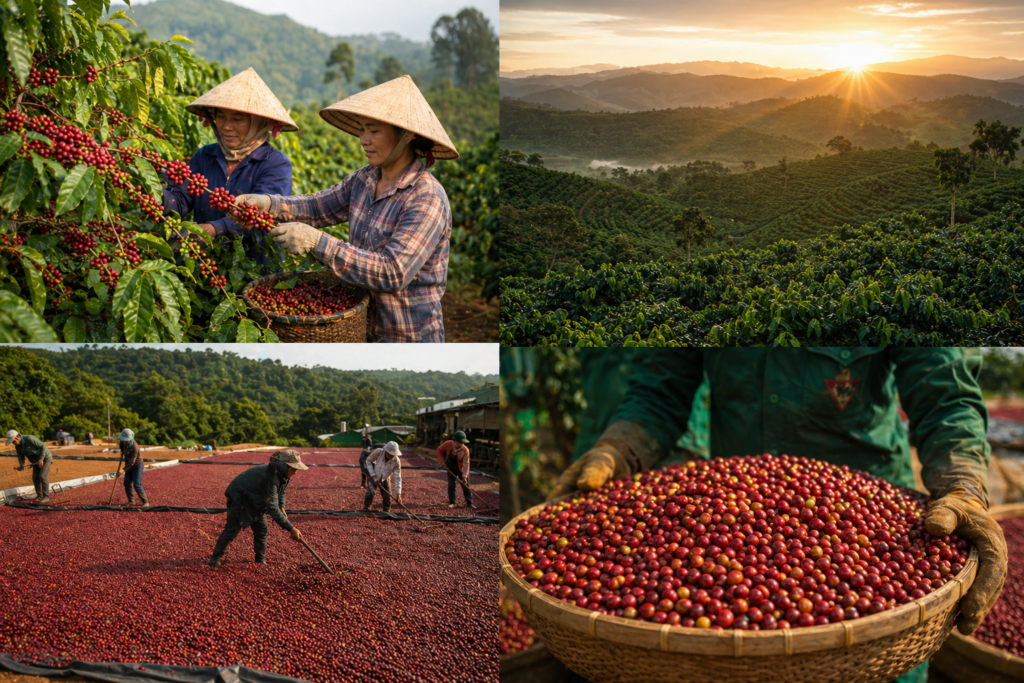
Vietnam remains the world’s largest robusta producer and second-largest coffee exporter overall, holding a foundational role in global supply.
Recent figures show:
- Vietnam exported approximately 1.58 million tons of coffee in 2025
- Export revenue approached US$9 billion, an all-time high
- Domestic robusta prices in early 2026 fluctuated between 84,000-97,000 VND/kg depending on futures volatility
- 2025/26 crop output is projected near 29-31 million bags, supported by improved production after prior drought years
Vietnam’s robusta sector benefits from:
Key strengths:
- Dominance in instant coffee and commercial blends
- Expanding deep-processing and soluble coffee investments
- Strong demand from Europe, China, and emerging Asian markets
Core vulnerabilities:
- Heavy dependence on maritime exports
- Exposure to fertilizer and fuel inflation
- Climate unpredictability in the Central Highlands
- Increasing compliance costs from EU sustainability regulations
While Vietnam’s larger crop could stabilize robusta supply, exporters face narrowing margins if shipping costs spike due to Middle East instability.
Middle East Conflict: Why It Matters to Coffee

Although the Middle East does not produce major coffee volumes, it plays a disproportionately important role in coffee economics because it controls critical trade routes and influences global energy pricing.
1. Strait of Hormuz Risk
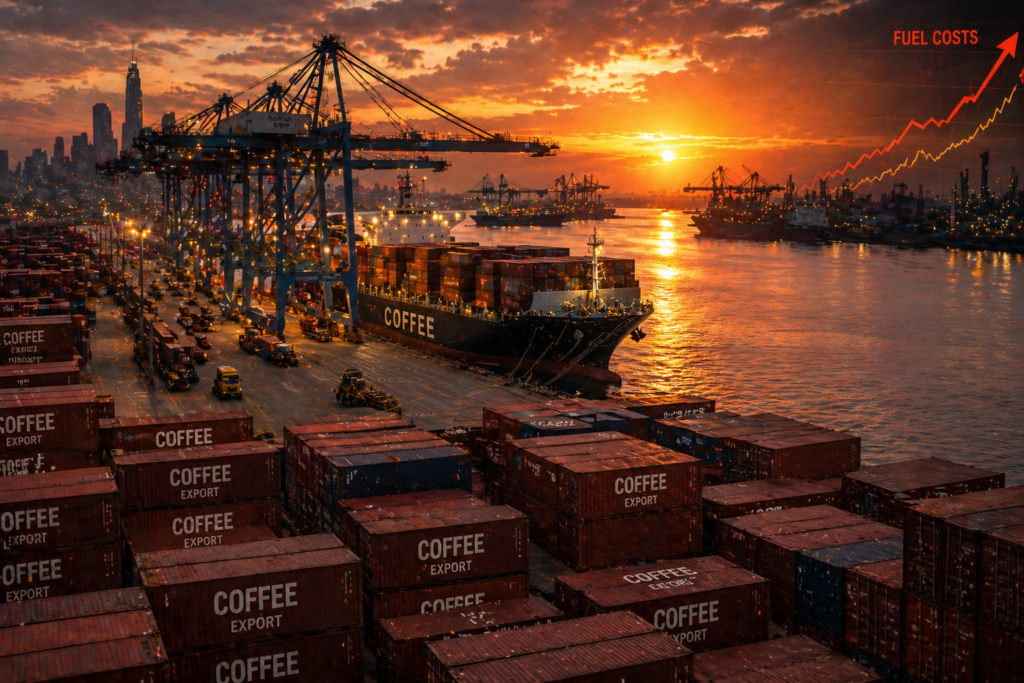
Roughly 20% of global oil shipments pass through Hormuz. Any prolonged closure or military escalation increases:
- Fuel prices
- Container freight costs
- Marine insurance premiums
- Delivery lead times for coffee shipments
For Vietnam, Brazil, and Indonesia, this directly raises FOB and CIF export costs.
2. Red Sea and Suez Canal Disruptions
Continued security risks force vessels to reroute around the Cape of Good Hope, adding:
- 10–20 additional shipping days
- Higher working capital requirements
- Increased warehousing pressure
- Reduced global coffee flow efficiency
3. Currency and Commodity Speculation
Conflict-driven volatility strengthens speculative buying in futures markets, pushing coffee prices upward even when physical supply improves.
This creates dangerous uncertainty for:
- Farmers
- Exporters
- Roasters
- Retail coffee brands
In essence, Middle East conflict acts as a “logistics tax” on the global coffee industry.
Climate Change: The Structural Threat Beyond War
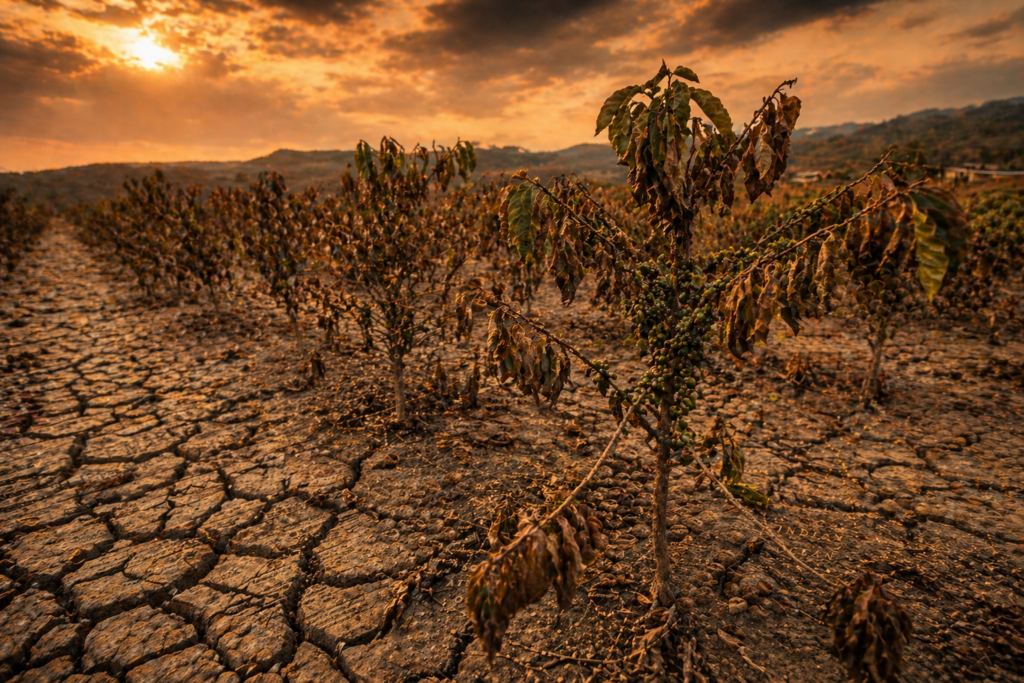
Geopolitical tensions may drive short-term price spikes, but climate remains the long-term existential risk.
Rabobank projections suggest that by 2050, nearly 20% of current arabica-growing land could become unsuitable due to rising temperatures, erratic rainfall, and increased drought. Brazil, Colombia, and Honduras are particularly exposed.
Climate – related coffee risks include:
- Lower yields
- Smaller bean sizes
- Quality inconsistencies
- Increased pest pressure
- Higher irrigation and production costs
Vietnam’s robusta resilience offers some advantage, but prolonged drought or irregular rains in the Central Highlands remain major concerns.
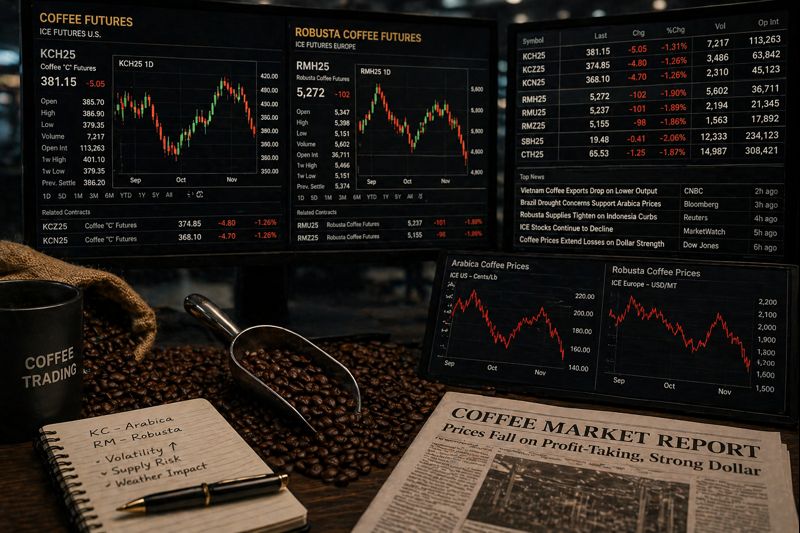
Coffee Price Forecast 2026 – 2027
Base Case (Most Likely)
If Brazilian production remains stable and Vietnam’s larger robusta crop reaches export channels, while Middle East conflict stays contained:
- Arabica: 260–330 cents/lb
- Robusta: US$3,400 – 4,300/ton
Bullish Case
If conflict worsens, Hormuz shipping disruptions intensify, and Brazil faces deeper weather stress:
- Arabica could exceed 370 cents/lb
- Robusta may return above US$4,800/ton
Bearish Case
If logistics normalize and speculative pressure eases:
- Arabica could retreat toward 230 – 250 cents/lb
- Robusta could soften to US$3,000 – 3,300/ton
Strategic conclusion:
Prices may remain historically elevated even during corrections because the coffee market has shifted from cyclical volatility to structural instability.
Strategic Challenges for the Coffee Industry
For Farmers:
- Rising input costs
- Greater weather unpredictability
- Margin compression despite high prices
For Exporters:
- Freight volatility
- Compliance costs
- Financing pressure from delayed shipments
For Roasters:
- Green coffee sourcing uncertainty
- Higher hedging costs
- Price sensitivity among consumers
For Investors:
Coffee is increasingly behaving like a geopolitical agricultural asset, similar to wheat or oil-sensitive commodities.

Final Outlook: Coffee in a New Era of Volatility
The global coffee industry is no longer operating in a simple supply-demand framework.
It is now shaped by:
- Climate disruption
- Geopolitical conflict
- Trade route instability
- Inflationary logistics
- Sustainability regulation
For Vietnam, this creates both unprecedented opportunity and substantial risk. As robusta demand rises globally, Vietnam is positioned to strengthen its strategic dominance – but only if producers, exporters, and policymakers adapt quickly to a world where volatility is permanent.