
In the intricate ecosystem that is the global coffee industry, few forces have had as enduring and as paradoxical an impact as taxation. From 16th-century imperial edicts to 21st-century trade policy, levies on coffee have oscillated between instruments of social control, revenue streams, and catalysts for market distortion. In 2026, as governments grapple with inflation, geopolitical friction, and the fallout from sweeping trade measures initiated in 2025, coffee taxes are once again commanding attention—not as relics of history, but as active shapers of the commodity’s future.
A Year of Swinging Policies and Growing Debate
Taxation on coffee has rarely been static, but the past 18 months have seen an unprecedented level of dynamism. In 2025, the United States under President Donald Trump introduced a series of broad import tariffs that cast a long shadow over the world’s coffee markets. Although many of these so-called “Liberation Day” levies have since been rolled back or adjusted, their initial announcement sent shockwaves through commodity markets, pushed prices upward, and ignited vigorous debate among economists, roasters, and producers alike.
Yet application of taxes isn’t limited to punitive trade measures intended to reshape global imports. Several consumer countries, wary of rising household budgets under inflationary pressure, have moved in the opposite direction—slashing or even abolishing duties to ease costs at the coffee counter. Brazil, for example, eliminated certain import duties on coffee and staples such as sugar and olive oil in an effort to blunt the impact of food inflation on consumers. Similarly, Denmark announced plans to phase out its coffee tax—originally levied in 1930 as part of a broader luxury goods duty—by 2027. And in India, the government dramatically reduced the Goods and Services Tax (GST) on instant coffee from 18% to 5%, a move celebrated by domestic producers as a catalyst for consumption growth and industry expansion.
These divergent policy trajectories—tariffs on one hand, cuts on the other—reveal a central tension in coffee economics: while import duties and tariffs are tools for managing balance-of-payments and trade leverage, domestic tax reduction emerges as a lever for supporting consumers and local industry. The question facing policymakers and market players alike is whether coffee taxation can be calibrated to serve both ends effectively, or whether it will continue to oscillate between competing objectives.
Tracing the Roots: Coffee and Taxation Through History
To fully grasp today’s policy debates, one must appreciate coffee’s historical relationship with the state. Taxation of coffee is not a modern phenomenon. In the Ottoman Empire of the 16th century, burgeoning coffeehouse culture was seen simultaneously as a social hub and a potential threat to state authority. Governments imposed levies to regulate the spread of caffeinated discourse and to augment treasury coffers. Later in Europe, monarchs such as Sweden’s King Adolf Frederick briefly banned coffee outright, cloaking protectionist measures for local industries under the guise of health concerns. Even in Prussia, “coffee sniffers” were reportedly employed to detect illegal roasting during periods when luxury taxes made home brewing prohibitively expensive.

These historical episodes underscore a perennial truth: taxation applied to coffee has always been about more than price. It has been about power, culture, and control. Today’s debates about tariffs, consumption taxes, and trade barriers are the latest iterations of this centuries-old dialogue between governments and the globally interlinked coffee economy.
Modern Tax Regimes and Their Market Impacts
In the contemporary world, taxation on coffee manifests in several distinct forms. Import duties—taxes levied on goods crossing international borders—remain a primary mechanism by which countries attempt to protect domestic industries or negotiate economic leverage. Yet these levies can have unintended consequences. High tariffs can distort market incentives, reduce competitive pricing for roasters and cafés, and even dampen overall consumption. In contrast, reductions in domestic consumption taxes, such as GST or value-added tax (VAT), can lower retail prices, stimulate local demand, and support broader industry growth.
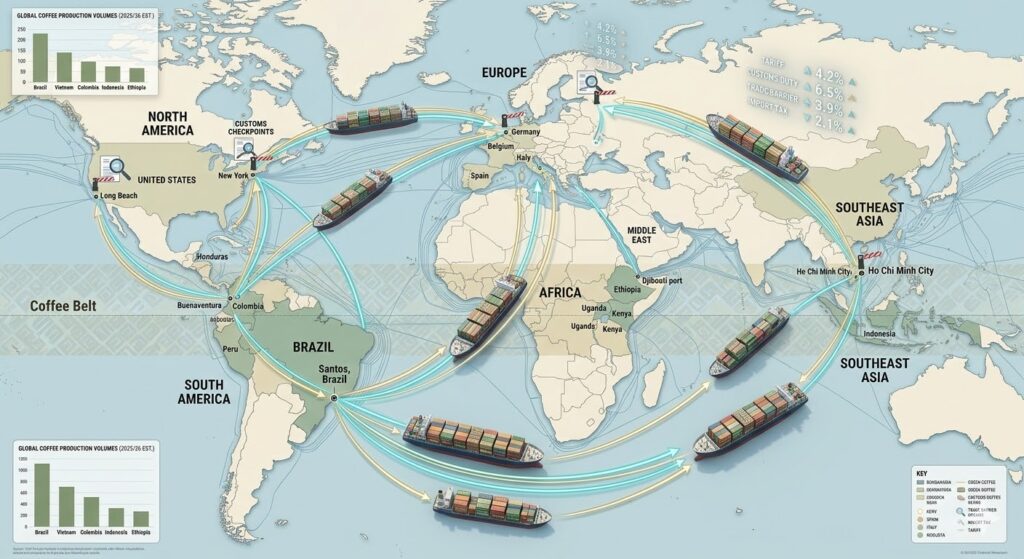
Trade policy decisions, particularly those affecting major importers like the United States and the European Union, reverberate throughout coffee-producing regions. Tariffs on green (unroasted) beans, roasted coffee, or soluble products influence sourcing strategies, supply chain configurations, and even investment decisions in processing infrastructure at origin. Meanwhile, policies that reduce or eliminate duties can invigorate domestic coffee markets, expand consumption, and reinforce the cultural prominence of coffee.
Consider the European Union, which currently imposes zero tariffs on green coffee but a modest 7.5% duty on roasted coffee. This differential is designed to encourage importing raw beans that can then be roasted domestically, theoretically adding value within EU markets rather than capturing it entirely abroad. This type of nuanced tariff regime demonstrates how taxation can be deployed not simply as a cost imposition but as a strategic tool for shaping industry structure.

The Way Forward: Balancing Policy with Economics
As 2026 unfolds, the potential for new policy innovations remains high. Governments continue to balance competing demands: protecting local producers, ensuring affordability for consumers, and navigating increasingly complex trade negotiations in a fractured geopolitical landscape. In this context, taxation on coffee—far from being a narrow technical issue—has become a bellwether for broader economic philosophy.
For stakeholders across the supply chain—from farmers in Ethiopia and Vietnam to roasters in Europe and cafés in North America—the key challenge lies in understanding how taxes intersect with prices, production incentives, and consumer behavior. At its best, thoughtful tax policy can lubricate the mechanisms of trade and consumption, enhancing market efficiency and broadening access. At its worst, poorly conceived levies risk erecting barriers, amplifying inequality, and distorting the very markets they aim to regulate.
Ultimately, the conversation surrounding coffee taxes is more than just an accounting exercise. It is a reflection of how society values one of its most beloved commodities and how public policy can help—or hinder—the economic vitality that flows from bean to cup. In an age of rapid change, the duty on coffee is both a historical echo and a forward-looking narrative, inviting policymakers and market participants alike to reconsider the role of taxation in shaping sustainable and equitable coffee markets for the future.